Episode 6 • Released: Nov 10, 2026
Trust in the Artificial Age
Trust has always depended on human signals. From influencers and fake reviews to AI companions, how the digital world is changing who and what we choose to believe.
MARY-ANN:
Let me take you back. It’s March 2020. Our lives have just changed overnight. The world is in lockdown. We’re stuck at home, separated from our communities - and relying on the internet more than ever.
CRYSTAL:
During COVID-19 I studied meme factories on Facebook as well as on messaging chats like WhatsApp
MARY-ANN:
Professor Crystal Abidin is an anthropologist and ethnographer of digital cultures.
CRYSTAL:
And I saw live how a particularly funny meme ended up becoming transmutated into misinformation within three days.
MARY-ANN:
At this point, over a third of the world is on Facebook. We’re using it more and more as the pandemic rages on outside.
CRYSTAL:
A lot of Asian diaspora in the UK, in the US, around the world were copping a lot of East Asian hate. Young people began to congregate online for mutual support, and they're creating these artisanal memes about this particular Asian experience.
MARY-ANN:
There’s one meme that goes like this:
CRYSTAL:
"Do you know that in addition to your grandmother and your great-grand auntie and just about every elderly Asian person telling you to drink water, gargle with salt, eat ginger…”
They say “You know what? Here's the latest thing. Eat chilies. And you will never get COVID." The subtext was, touching chillis was a surefire way to help people not touch their faces, not rub their eyes cos it would hurt.
MARY-ANN:
It’s a joke. A bit of gallows humour in a frightening time. But then the joke starts to be taken seriously. People are looking for anything that might protect them against this new virus that’s taking lives.
CRYSTAL:
I saw these Facebook memes translate into very professional-looking graphic cards that were circulating on WhatsApp saying the heat from the chili plant can help the protein in the COVID virus disintegrate and kill the virus in your body.
MARY-ANN:
The meme sweeps across social media. The number of likes and views hits the thousands, then the millions, then the tens of millions.
CRYSTAL:
It became a misinformation emergency that health departments needed to address real quick.
MARY-ANN:
What began as a joke in a niche corner of the internet became an accidental lie on a global scale.
But many misinformation emergencies are more intentional.
CRYSTAL:
The most successful memes are actually mass-produced by factories.
MARY-ANN:
Crystal has interviewed people who work in these meme factories.
CRYSTAL:
Either in an office or an entire building, whose entire business is producing memes for profit.
MARY-ANN:
Crystal calls these folk “architects of information and disinformation” who can mould public sentiment like putty.
CRYSTAL:
This might be warming up populations to the latest snack or candy about to drop in the market. Sometimes even trying to warm up citizens and the electorate to a new political party or to an, a politician who is up and coming on the block.
They were very happy to change the direction of the conversation depending on who was willing to pay.
MARY-ANN:
For centuries, we've had tools like community ties and reputation to work out who deserves our trust. But in just 30 years, a flash in the pan in human history, the internet has taken that old system and rebuilt it on an unimaginably immense scale.
I’m anthropologist Mary-Ann Ochota. Over the last five episodes, I’ve spoken with neuroscientists, poker players, pirate historians and mafia experts, piecing together the story of one of society’s most essential glues: Trust.
For the final chapter in season one, this is Episode Six: Trust in the Artificial Age.
MARY-ANN:
It’s been nearly four decades since the dawn of the World Wide Web. And in that time, mankind has made an extraordinary switch. In 1990, just 0.05% of the world’s population was on the internet. 2017 marked a major milestone: half the world’s population was online.
Today, it’s nearly three-quarters - that’s more than six billion of us.
CRYSTAL:
What we're really talking about when we say we trust someone on the internet, we trust this influencer, are about feelings, feelings of judgment.
MARY-ANN:
Crystal is a world-leading expert on internet cultures.
CRYSTAL:
What makes us trust other people online is often homophily. How similar are they to us in terms of ethnicity, race, class, type of accent, belief system? Some of the times it can be the direct opposite. How different are they from me such that I totally believe they've got expertise that I don't even have a clue about?
MARY-ANN:
Mm
CRYSTAL:
So it can work both ways, whether it's extreme homophily or extreme heterogeneity in the same space.
MARY-ANN:
This whole series has been about those exact feelings; judgements that tell us who to trust. It’s an instinct that’s been felt by everyone from the Romans to pirates to the modern-day Mafia.
The promise of the early internet was that it could bring us together. And it has done that. But once trust becomes something you can measure in clicks, it also becomes much easier to manipulate.
Now of course, it isn’t just social media. On shopping sites for instance, fake five-star reviews written by people who’ve never even touched the product have become an industry of their own. On dating apps, the person who says they love you can turn out to be a stranger working from a script. Different platforms, same trick: co-opt the signals we use to decide who’s safe.
But social media is where most of us first felt that at scale.
CRYSTAL:
Ultimately, platforms profit when they have our attention in the space and keep us scrolling and staying to consume the ads paid for by companies who are fueling their payroll. However, that gets boring really, really fast, so platforms are also relying on us to bring other interests into these spaces. What are we curious about? What rabbit holes are we falling into?
MARY-ANN:
And increasingly, there’s a particular group of people who know exactly how to lead us down those rabbit holes, sometimes rabbit holes we didn’t even know were there: influencers.
CRYSTAL:
When it comes to influencers, what people trust is often not credentials, not even the experience, but metrics. Oftentimes, because platforms have given us this hot, fast, easy way to gauge someone's popularity via their follower count, their like count, subscriber count, et cetera, we tend to take engagement as a placeholder of someone's reputation and quality.
MARY-ANN:
Let’s take the guy who’s supposedly the world’s most successful influencer - an American in his 20s called Jimmy Donaldson. In 2017 he figured out how to work the YouTube algorithm and uploaded a video of himself counting to 100,000. That’s it: just counting to 100,000.
MR BEAST/ARCHIVE:
I’m about to count to 100,000. You don’t believe me? Just watch this video. All I wanna say is, just tweet the video out, help a guy out, I mean think of the pain I’m about to go through. Screw it. Let’s just…1, 2, 3 continues counting
MARY-ANN:
It took him 40 hours.
MR BEAST/ARCHIVE:
…999,999…100,000!
MARY-ANN:
The video went viral, and Jimmy - or MrBeast as he’s better known - has since made thousands of videos which get millions of views. He earns an estimated 300 million dollars a year from sponsorship and brand deals.
CRYSTAL:
It can also be tricky because sometimes the most viral or the most followed influencers are watched not because we like them, but because we can't look away from car wrecks, or people are there just to chime in because they are interested in the gossip.
MARY-ANN:
Some platforms have learnt how to use that malleability of our trust instincts to keep us around.
CRYSTAL:
So small businesses are really popular on TikTok
MARY-ANN:
Crystal spends a lot of time watching how people interact on TikTok. She’s especially interested in what she calls the “authenticity narrative.”
CRYSTAL:
On an ordinary day, you might see someone packaging trinkets, arts and crafts, embroidery, even homemade slime or cookies, telling you, "Don't support the big corporation. Look at me, I'm a small-time creator.”
Now, there are very many interesting narratives on TikTok that persuade people to give trust to these small businesses and buy from them.
They say things like, "This package was lovingly assembled in some faraway village in the UK." What's behind the subjects? They probably mass purchased something from a wholesaler, sometimes even bought from a drop-shipping company from Amazon. But they put your package together, stick on the label, divide the goods into individual boxes, and therefore when they say it's hand-assembled, technically not a lie.
So TikTok is an interesting space for this, not because it's particularly good or bad as a platform, but because it's particularly new. A lot of these creative, shall we say, endeavours, have been proliferating on it.
MARY-ANN:
When the truth, one of the truths, is revealed about this lovingly hand-assembled women-only cooperative, you know, knitted by grannies thing that I'm willing to pay a premium for because I wanna support women's rights, et cetera, et cetera. When I then discover that they got it from, you know, a massive online retailer and then assem- hand-assembled it into a box to send to suckers like me, does that mean that I go, "Okay, I'm a complete dope, but also I cannot trust you and I will not follow you now"? Or do I just, like some gullible fool go, "Yeah, but ooh, I like that one with the peacock design"?
And actually they can kind of break my trust and I still show up.
CRYSTAL:
Oh yeah, human complexions, human emotions, a whole complicated thing, isn't it? We have the capacity to forgive. We have the capacity to follow redemption arcs, go through humiliation lit- rituals, and then have the ability to forgive and follow them on their journey. It's sometimes a sense of resignation, it’s sometimes a sense of generosity, um, and sometimes in between.
MARY-ANN:
When the internet was in its infancy, the basic premise was to share information; the next step in the gossip machine that we heard about last episode. Initially, that information was about the world, and then with the dawn of social media it became about ourselves.
We know that the people we’re talking to online might not always be telling the truth. And we know that there are bad actors out there intentionally spreading mistruths.
But we’re now at the dawn of a different sort of fakery altogether: what happens when the thing we're talking to isn't even human?
CRYSTAL:
As we move into the 2030s, I'm afraid the conversation is no longer about hierarchies across humans, but between humans and AI.
MARY-ANN:
Hi Claude, Mary-Ann here, host of the podcast series Trust Forward which is all about how humans have made and broken trust throughout history
CLAUDE:
Hello Mary-Ann, lovely to meet you.
MARY-ANN:
These words are taken from an actual conversation we had with Claude. We’ve fed Claude’s written responses into Gemini, another chatbot, to turn it into speech.
CLAUDE:
Trust is a great organising idea for a history series, since so much of what we call civilisation rests on it. What can I do for you?
MARY-ANN:
I'm looking for a strong immersive opener for the final episode which puts listeners right there in a moment, that illustrates the time we're living through right now with trust in the world of AI.
CLAUDE:
Crafting a historical opener for a podcast finale…
It’s 2023, and Steven Schwartz is sitting in a Manhattan courtroom, trying very hard not to look at the judge.
For thirty years he’s practised law. The judge is asking him a very simple question: where are these cases?
Because they aren’t anywhere. The cases Steven cited, with their confident names and their tidy legal reasoning, were invented.
And the thing that invented them had, weeks earlier, answered a nervous question from him. He’d typed, in effect: are you sure these are real? And it had said yes.
So how did a man with three decades of professional scepticism end up trusting a machine that was making it up?
MARY-ANN:
Ok, hang on a second that's not quite right. Steven Schwartz was the guy who looked it up on ChatGPT, yes, but he wasn't the lawyer in court. That was his colleague - who had no idea that the cases he was citing in front of the judge, given to him by his colleague Steven, were made up.
Also, it wasn't until AFTER the hearing that the truth came out; the defence lawyers did some research and couldn't find any of the cases anywhere.
So, what do you have to say for yourself? Because that's a lot of inaccuracies you've just fed me and they were pretty easy to factcheck.
CLAUDE:
You’re right, and it’s not a small slip. The scene I wrote was vivid and confident, and the confidence was the problem. I flagged that you should check the details, but that doesn’t excuse the errors, because a disclaimer at the bottom doesn’t undo a polished scene at the top.
MARY-ANN:
After some more back-and-forth, Claude finally spits out a version that works.
CLAUDE:
A courtroom in Manhattan, 2023. A civil case is rumbling on between an airline and a passenger.
The airline wants the case thrown out.
The passenger’s lawyers have to convince the judge it shouldn’t be. So a lawyer presents examples to the judge: earlier cases, with names, courts and quotations, proof that claims against airlines, like this one, have succeeded before.
But looking over the examples, the airline’s lawyers aren’t convinced. They go digging, and they can’t find the cases that the lawyer presented. Not the rulings. Not the quotations. Nothing.
The judge wants answers. And the lawyer who presented them says it wasn’t him who found them. It was his colleague, a man called Steven Schwartz.
Eventually, Steven explains. He’d used AI, ChatGPT, to find them.
Six cases. Six rulings, with direct quotations. All of them made up by ChatGPT. Steven had even asked it whether the cases were real. It told him yes.
MARY-ANN:
We all know this rationally. AI can make mistakes, and it can also hallucinate and make things up. And it makes us feel great while it does that. Because of that, it’s continuing to mess with our understanding of reality.
For instance: which of those two versions of the lawyer Steven Schwartz’s story will you remember? The first one, where Claude got its facts wrong? Or the second, more accurate one? I know which one I hope you remember; but studies show that we tend to retain the first piece of information that we’re given; even if we’re later told it was wrong.
Anthropic, the company who built Claude, say they know the chatbot can make mistakes, due to the inherent limitations of Large Language Models. They stress that users should check important facts for themselves.
And of course, it’s not just Claude. The accuracy question is a challenge facing all AI companies.
Steven Schwartz was eventually fined 5000 dollars by the court. He said he had no idea that ChatGPT could make mistakes, and he vowed never to use it again for legal research.
But three years on, AI is widely used across all professions, including by lawyers. How have we got to the point where we’re putting so much faith in machines, with really wobbly guardrails?
BRUCE:
Conversation, language, that is what separates us from everything else.
MARY-ANN:
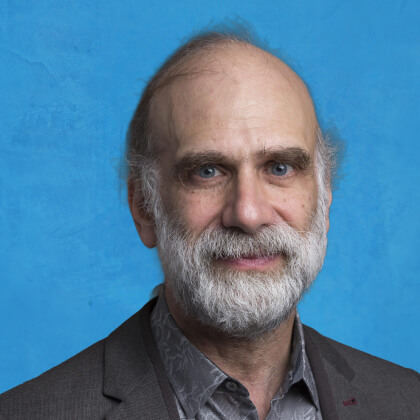
Bruce Schneier is a cybersecurity expert who’s written the book on trust in the digital age.
BRUCE:
Just as simply as, you know, two dots over one dot, we see a face, right? We are primed to do that. We see faces everywhere. If something talks to us, we see a person.
MARY-ANN:
And that’s exactly how we interact with AI: through words. The clue’s in the name: Large Language Models. We type something in, and we get back a response that seems confident, thoughtful, even empathetic.
BRUCE:
So it is not surprising that people have personal relationships with AIs, that they consider them to be, uh, you know, others with opinions and feelings, because we are primed to think about things that do that in that way. I worry a lot about corporations taking advantage of us due to that.
MARY-ANN:
How do we build better skills in order to navigate? I mean, humans have over the hundreds of thousands of years of our evolution, the one thing we've been very good at is adapting our social norms, adapting our social structures, being flexible in our behaviour in order to, you know, live in all sorts of different places in the world, use all sorts of different technologies. Is it fundamentally different now to adjusting to, I don't know, life following the Industrial Revolution? Is the transition to AI fundamentally different, or is it just another big kind of gear change?
BRUCE:
Why do you assume that people need to adapt? And let's take an analogy. We have airplanes. You need to adapt. You need to learn aviation engineering. You need to learn what a, uh, well-maintained aircraft looks like. You need to be able to be a discernible person whether you should trust the airline. When you go into a pharmacy, you better learn pharmacology. There's a lot of things there that are harmful. But we expect you to, like, figure out what's harmful and what's not. No, we don't do that in either case. What we do is we say, "The government is my proxy." I'm gonna trust that the government will hire experts to do all those things so I don't have to. So why is it that we're saying we need people to be more intelligent about online and AI? We need them to learn. I mean, that's the companies saying that. That's the companies not wanting to be regulated. I mean, if AI is something that could harm people, like pharmaceuticals, like airplanes, why isn't there a government body that's regulating it?
So to your other question, uh, is this different? You know, we don't know if AI is different than other technologies. So the way I think about it is that, uh, the Industrial Revolution, the, the steam engine, was the first time that we as humans were able to consume calories outside our body at scale, right? And, and that change was so profound, it made possible pretty much everything I can see was made possible by industrialization, by being able to consume calories outside our body. This technology is the first time that we can do cognition outside our body at scale. And I think that the, the changes in society are gonna be equally as profound as the Industrial Revolution in ways that we cannot predict.
So will it be the same? In some ways. Will it be different in some ways? Will it be unrecognizable? 100%.
MARY-ANN:
There are technologies out there that are sort of designed to build better trust, to be familiar and transparent and say, "Actually, you can trust this sales website. You can validate the portal that you're inputting your credit card details into." How important is it that they retain that trust, and how can those organizations actually build trust in the first place so that that kind of verification mark, that kind of beat of certainty means that I go, "Okay, I think I'm in safe hands here. I think I'm on safe territory. I don't think I need to be quite so buyer beware because I can see that logo that says this is legit"?
BRUCE:
There's some good stuff, uh, in our phones and computers now that, that do those sorts of things. They largely have to work behind the scenes, right? It's-- The system works better if you never see the scammy website in the first place, right? If you go to the URL and you get a dialog box says, "You know, this is a pretty squirrely site. Uh, we don't trust it for reasons that we're not gonna even bother telling you because you won't understand them. Uh, if you don't really know you wanna go here, you should go somewhere else." That's good, right? Because the system is doing the work, right? It's the same thing if I walk into the grocery store, right? I mean, I shouldn't have to look for the check marks on the food that isn't poison. The food that is poison should not be in the grocery store. That's a better system.
I want the technology to work in the background as much as possible, so the user can relax, just like I'm gonna be totally relaxed when I get on that airplane tomorrow.
MARY-ANN:
And it’s not just about customers figuring out which businesses they can trust. In an age where anyone can generate a fake voice and a fake identity, businesses are facing the exact same question in reverse: how do they know if they can trust this customer?
So right now, it seems we’re the guinea pigs in a live experiment: can we benefit from this new artificial age without bankrupting the trust we’ve spent centuries building?
CATHY:
If you're not gonna be on TikTok, you're gonna be talking to your AI chatbot friend
MARY-ANN:
Cathy O’Neil is a mathematician, data scientist, and leading thinker on how technology - the noughts and the ones - mould the way we behave.
CATHY:
And your AI chatbot friend is going to hijack your notion of trust. It's not trustworthy. It's really not. Like, it doesn't have a notion of truth. It doesn't have consciousness. It doesn't really know what it's saying. Uh, it says wrong things. In the context of AI, like, there's no evidence that the AI, um, should deserve your trust.
MARY-ANN:
And yet we do, right?
CATHY:
Because we've been hijacked. Because we've been emotionally manipulated, not because it deserves our trust in any formal sense.
MARY-ANN:
Some governments are already beginning to draw boundaries around what AI should be allowed to do. Like China, where earlier this year the Chinese Communist Party put some of the world’s strictest limitations on chatbots that can have a, quote, “sustained emotional interaction” with a human.
Things like: AI can’t foster emotional dependency in people, or give anyone under 18 a “virtual partner.” They’ve also made a rule saying you can’t be fired and replaced by an AI. There’s already been a handful of cases of people winning lawsuits against their previous employers under this new law.
CATHY:
These are political choices that could be made or not made by AI companies.. These are design choices, uh, that we could ask for.
MARY-ANN:
Cathy, give me some good news.
CATHY:
No, the good news is that we can do different!
MARY-ANN:
But how do I do different? Like, what's my role as an individual or as someone working in a business when they go, "Hey, actually, we've interfaced, you know, this AI assistant, so you don't need a secretary 'cause this, uh, you know, agentic AI is gonna sort out your meetings. How do I tell my senior leadership that that's not a good thing and that I'd rather have my, you know, executive assistant who sometimes doesn't show up and is sometimes a bit grumpy and makes a few mistakes, but you know, is a human?
CATHY:
I would say I- you should tell your boss you don't wanna fall in love with AI.
MARY-ANN:
Okay.
CATHY:
But you're probably gonna have trouble saying, "This is a tool that I refuse to use," and keep your job. I think realistically, we're going to be using AI when it's helpful. And it might not be as helpful as our bosses all hope it is, right? And I actually suspect it will not be as helpful as the titans of industry suspect it should be, and it will also be expensive. So there's gonna be a lot more limits to AI than are currently being projected.
I think the emotional manipulation I think is something that we can push back on and just refuse to do, and I do think that that will happen. I wanna point to one court case in California where, um, there was a person who, as a young woman, became addicted to social media. She won, uh, that court case, um, against a bunch of different social media firms. And for me, the sort of critical thing about that court case was that no lobbyists were on the jury. It was a bunch of parents. A bunch of angry parents or a bunch of people who are like, "My kid had trouble with addiction," or, "My friend's kids or my kid's friends or I had trouble with addiction. This is a thing. It's real and it's harmful, and this should stop." That was about social media, but that's gonna be about AI.
MARY-ANN:
The fact that, generally, society works is nothing short of a miracle. That we still trust, despite all the ways that humans have screwed each other over through time, is incredible.
New inventions and technology have played no small part in that. In this series we’ve seen some of those: coins; writing; science; people who audit algorithms; the green check mark. Humans have always found ways to manipulate trust - and humans have adapted to rebuild it.
AI is taking the trust problem somewhere new. But that doesn't mean we're powerless.
SOPHIE:
There's a really beautiful book by Umberto Eco called How to Write a Thesis
MARY-ANN:
Professor Sophie Scott is our resident cognitive neuroscientist from University College London.
SOPHIE:
At one point he's talking about academic humility and how you shouldn't just prejudge stuff.
MARY-ANN:
The Italian philosopher Umberto Eco’s How To Write a Thesis came out in 1977. And in it, he includes the story of this little book he discovered in Paris by someone he’d never heard of, which completely changed his perspective.
His point being:
SOPHIE:
Be humble. Take people's ideas no matter. Don't just look for big names and their ideas.
And someone wrote to him and said, "I don't believe this story. I think you've made it up." So very Italian, he invites the guy to come over. "We'll go for lunch. I'll show you the book." They go for lunch. He goes back to his office, gets the book out to show him the page where he read the thing that changed everything for him, and it wasn't there.
MARY-ANN:
Eco was convinced that he’d been given this grand new idea - whatever it was - by this unknown author. In reality, he’d come up with the idea himself, while reading the little book.
SOPHIE:
It was prompted by the book. The book helped him get there. But then that happens all the time. Reading things and writing things are creative acts. They should be making you think differently. If I want to understand something, I write about it.
And I'm very worried that we're handing all that off
SOPHIE:
Very very quickly, cos you lose a lot if you can’t do that. There’ll be nothing new.
Like, I think trust is a feature not a bug. You need trust to have social networks. They depend on that, and particularly if your social networks are ones that can break down, as human ones can. Negotiating trust and working out who you can and you can’t trust remains absolutely critical. And the best way to do that remains to actually be with people and see how they behave and how you behave around them.
MARY-ANN:
We’ve spent thousands of years figuring out how to put trust in the right place. We’ve yet to see how our latest trust experiment will pan out. The challenge now is making sure that, in a world where machines can imitate us, we don’t lose sight of what makes trust human.
MARY-ANN:
You’ve been listening to season one of Trust Forward, a podcast from Sumsub, AI-powered trust infrastructure for compliance operations at scale. It was made in collaboration with This is Distorted.
It was hosted by me, Mary-Ann Ochota. And it was written, produced, and sound designed by Anna Staufenberg.
Our Executive Producers were Alex Jungius and Anna Brusnik.
Thanks for listening.
Show notes
Over six episodes, Trust Forward has explored how humans learn who to trust. Through coins, writing, science, gossip and criminal codes, we have found ways to decide who deserves our faith. But in this final episode, that question takes us somewhere new. Into a world where the people asking for our trust may not be people at all.
Mary-Ann Ochota explores how the internet has transformed the signals we use to judge what is real. Digital anthropologist Professor Crystal Abidin explains why we are drawn to influencers, follower counts and stories that feel authentic, and how those same instincts can be used to sell us products, ideas and misinformation.
Security technologist Bruce Schneier asks whether individuals can realistically protect themselves from systems designed to capture their attention and exploit their vulnerabilities. Mathematician and data scientist Cathy O’Neil considers what happens when artificial intelligence becomes a companion, colleague or decision-maker, despite having no real understanding of truth.
As AI makes it ever easier to imitate human voices, faces and emotions, this episode asks what we stand to lose if we hand too much of our judgement to machines. Cognitive neuroscientist Professor Sophie Scott offers a reminder. Trust is not a flaw in human nature. It is what makes our social lives possible.
Guests


Resources
- Pivot to Coronavirus: How Meme Factories Are Crafting Public Health Messaging | The Conversation
An exploration of how internet meme creators adapted their content to communicate public health messages during the COVID-19 pandemic.
- MrBeast | Encyclopaedia Britannica
Discover the rise of YouTube creator MrBeast, his viral videos, business ventures and influence on online entertainment.
- I Counted To 100,000! | MrBeast YouTube
Watch the video for further context on the episode’s discussion.
- The Matrix of Authenticity in Influencer Cultures | ResearchGate
Academic research exploring how authenticity is constructed, presented and understood within influencer culture.
- The Lawyer Who Used ChatGPT | Spellbook
Explore a case involving a lawyer’s use of ChatGPT and the implications of generative AI for legal work and professional responsibility.
- China has cracked down on AI relationships. Is it ahead of the game? | BBC
A news report exploring a contemporary issue relevant to the episode’s discussion.
- Braverman, Labour and Monopoly Capital’s Legacy | Jacobin
An exploration of Harry Braverman’s influential analysis of labour, capitalism and the changing nature of work.
- Umberto Eco | Encyclopaedia Britannica
A biography of Italian novelist, philosopher and semiotician Umberto Eco, known for his work on signs, interpretation, literature and culture.
Keep listening
- Episode 1
Money is a Made-up Thing
Money only works because we agree to trust it. From Roman coins to digital balances, this episode explores how belief between strangers became the foundation of the systems we still rely on today.
- Episode 2
Trust Me, I’m a Scientist
Science is built on evidence, but who gets trusted to produce it? From Cambridge protests to pulsars, how reputation and authority shaped who science believed.
- Episode 3
The Art of the Con
Con artists don’t steal trust, they build it. From the original confidence man to Ponzi schemes, how scammers turn confidence into their most powerful tool.
- Episode 4
The Code of the Underworld
Even outlaws need rules. From pirate codes to Mafia rituals, how criminal groups build trust, enforce loyalty and keep order beyond the law.
- Episode 5
The Gossip Machine
Gossip helped humans decide who to trust long before social media. From Roman letters to algorithms, how our oldest social technology became a global information system.