

Episode 5 • coming soon
Before Spreadsheets, There Was Gossip
Lloyd's Coffee House to R.G. Dun & Co. How reputation moved from conversation to ledger to algorithm. The moment trust stopped being personal and became a number.
Episode 2 • Released: Sep 15, 2026
Science is built on evidence, but who gets trusted to produce it? From Cambridge protests to pulsars, how reputation and authority shaped who science believed.
MARY-ANN:
It’s May 1897, and we’re in Cambridge, England. Science is changing fast: new discoveries about everything from evolution to electricity are challenging old ideas about the natural world.
But only some people’s ideas are being listened to. Cambridge has been accepting female students in some colleges for a couple of decades already, but women are still not allowed to get a degree.
And on this day, it’s a hot topic. Staff and students across the university are voting for whether that should change.
As the debate begins to take place inside, a sea of men - and some women - in boater hats swarms onto the streets outside.
ANGELA:
There were huge protests. There was so much fear and anger about it.
MARY-ANN:
Angela Saini is a journalist whose books about the history of science have consistently topped the charts.
ANGELA:
If you imagine Cambridge has these very small, little narrow lanes and streets all around the university. Just these streets, completely chockfull of young men protesting against the admission of women.
MARY-ANN:
One banner reads: “No Gowns for Girtonites” - Girton being a women-only college.
Elevated in mid-air above the heads of the crowd, hanging by a stick from a nearby window, is an effigy of a woman. She’s straddling a bicycle.
ANGELA:
Because a woman on a bicycle was kind of a symbol of the independent woman
MARY-ANN:
The results of the vote are in. The proposal’s been rejected. Women can continue to study here in their women-only colleges, but they won’t be able to get a degree.
The delighted protesters tear the effigy down, rip off her head, and parade her through the streets, before throwing her onto a bonfire, and watching her burn.
ANGELA:
And you have to wonder what was going on in their minds. What were they really frightened of? What did they think they were losing by having women sit alongside them in the lecture halls?
MARY-ANN:
This wasn’t just a fight over who got a degree. It was a much bigger argument permeating western academia. It wasn’t just about discovering what was true; it was also about deciding who was qualified to say what was true.
The scientific method is ruled by reason and evidence. And for centuries, only certain groups of people have been trusted to do it correctly.
I'm Mary-Ann Ochota. I'm an anthropologist and archaeologist, and this is Trust Forward - a history podcast.
Across six episodes, we're following the story of this sticky thing we call trust. From money to conmen, pirates, gossip and into the digital world, we’re exploring one central question: how have humans decided what, and who, to believe?
Episode Two: Trust Me, I’m a Scientist.
ANGELA:
There has always been science of a kind, right? If science is just us humans trying to understand the world and how it works, beginning with agriculturalists and animal domesticators.
MARY-ANN:
Angela is Assistant Professor of science writing at the Massachusetts Institute of Technology. Her books Superior, and The Patriarchs explore how science has been shaped by ideas about gender, race and power.
ANGELA:
But, what you get around the 17th century is a professionalization of science, so turning it into an enterprise that has rules of governance, gatekeepers, people who decide what will go forward and be considered acceptable ideas and what kind of ideas will be rejected.
MARY-ANN:
This was around the same time as a new intellectual movement was taking hold across Europe: the Enlightenment. Where reason and rationality are everything.
ANGELA:
The idea that ideas are testable through the empirical method, we can establish truths, and they hold in every context.
MARY-ANN:
And if you wanted to turn those new ideals into an institution, there was one place in Britain where you could see them taking shape.
Throughout history, knowledge about the natural world was often shared through books and letters. Reputation and personal networks played a big part in deciding whose claims were worth believing.
But then, in 1660, a group of men in London founded the Royal Society - an organisation built around a radical idea: don’t just trust the person making the claim. Share it, test it, scrutinise it.
The Royal Society is still one of the most influential scientific institutions in the world today. But from the beginning it was also a club, with strict rules about who could get through the door.
It began with just 12 members. And that number steadily grew through the centuries.
ANGELA:
A lot of these scientists were not working with universities. They were working on their own in their basements or in their homes. If you go to Darwin's house, for example, Down House, you can see that's where he was working. You can see his desk and all his books and all his work. So it, it was a…there was already a degree of gatekeeping going on just in terms of, um, economics and who, who had an education.
MARY-ANN:
Who's got a spare room
ANGELA:
Who's got a spare room, but also who has an education. A lot of people, you know, literacy rates only really shoot up in the late 20th century around the world. So the Royal Society, in that sense, already at its outset is really a collection of gentlemen scholars, the people who can afford to do this and have the standing, the social standing to present their work and share their work in a way that will be disseminated amongst themselves.
MARY-ANN:
But in those wealthy, literate households-
ANGELA:
Mm-hmm...
MARY-ANN:
There are both sons and daughters. Right? Sometimes we kind of see in, in people's diaries and stuff that their wives or their daughters are assisting with this scientific endeavor. But then they don't get to front the, the research. They don't get to present it in public. They don't ever get recognized.
ANGELA:
Yes. And not just assisting. There are very many women scientists and technologists even during those centuries who were doing work themselves, and sometimes it would, um, be presented as their husband's work even though it was their own work independently, and it might be presented together but, you know, the man's name would come first.
MARY-ANN:
Like Charlotte Murchison, for instance. She was a keen geologist and fossil collector who did loads of research and drawings for her husband’s work in the 1800s. It’s said that, without her, her husband wouldn’t have been a geologist at all. But she wasn’t credited, because women’s expertise simply wasn’t trusted. They were irrational, a little bit hysterical, and obviously not very accurate.
ANGELA:
It was so ingrained that this, this just has to be true, and of course it didn't come from biological observations. It came from social observations.
That explains a lot of why you see such a dearth of, um, women and working-class people within the sciences until the middle of the 20th century. It's not a question of them not trying. It's a question of not having the chance in the first place.
MARY-ANN:
Women were only allowed to become members of the Royal Society in 1945. Nearly three centuries after it was founded.
But this isn’t just a story about women. For centuries, who got to be seen as a scientific authority was massively influenced by education, class and race.
Take Aristotle. People already had huge respect for the philosophers of Ancient Greece, and Aristotle - who was rich and mixed in the right circles - became one of the biggest authorities on the natural world. So even when he came up with some pretty strange ideas - like that men have more teeth than women, for instance - nobody thought to test his theories.
And then at the opposite end of the spectrum, you’ve got the Hungarian doctor Ignaz Semmelweis. Working in Vienna hospital in the 1840s, he realised that the reason so many women were dying in childbirth was because the doctors weren’t washing their hands, after cutting up dead bodies. But he was ignored - the gentleman doctors were mortally offended at the idea that they were ‘dirty’. He had the evidence, but he didn’t have the authority.
And then there’s Francis Williams. He was a Jamaican scholar and mathematician who went to meetings at the Royal Society in the early 1700s, but was refused full membership, quote, “on account of his complexion”.
ANGELA:
You know, these color-coded, especially racial groups that we think of today, like white, Black, brown, yellow, red, they were only invented in the 17th century. They didn't exist before that.
MARY-ANN:
Let's talk about reputation in science. Because on one hand, you think, actually, if we're talking about empirical, testable evidence then anybody who presents evidence should be tested in the same-- that evidence can be tested even-handedly.
ANGELA:
Yeah.
MARY-ANN:
But actually, the reputation of who the scientist is has a huge impact, doesn't it?
ANGELA:
Well, it's interesting. I think we have to remember, we tend to flatten history, right? And we, we remember certain people, and then those people form a narrative in our minds, and then that's all we ever think about. So there is this kind of narrative that men who do science are automatically trusted, women who do science are not automatically trusted. And it's more complicated than that, because even in their own times, people would've told you that there are fights, disagreements, there's battles between ideas and also between the individuals behind those ideas. And that means that we remember certain people and not others. There's a reason that we remember Charles Darwin and not Alfred Russel Wallace in the same way.
MARY-ANN:
Alfred Russel Wallace was a British naturalist and explorer who spent years collecting specimens in the Amazon and Southeast Asia. He independently came up with the theory of evolution by natural selection, and even sent his ideas to Charles Darwin. But Darwin had a much wealthier background, and he’s the one we remember.
ANGELA:
A really good example of this is Galileo.
MARY-ANN:
The astronomer and mathematician Galileo Galilei, in the mid-1500s, didn’t have huge social connections behind him. But the powerful Medici family took him under their wing, giving him status, money and a platform for his revolutionary ideas about the way the universe worked.
ANGELA:
But there were also loads of people trying to drag him back, the Catholic Church in particular. No, you know, the idea that the Earth doesn't go around the sun was so challenging to the Catholic Church, so there were very many people in his own lifetime who were trying to destroy his reputation. But then there were very many others who were trying to build it up. So there were these fights even then about whose authority should be trusted. Should it be the church or should it be the scientists, these kind of dangerous renegades who are challenging everything we thought we knew about the universe? And that continues, you know, well into the 20th century. There is a reason that's, you know, there are certain figures from science who are uppermost in our minds and others who kind of drift away, and part of it is because of how their reputations were nurtured and developed and-
MARY-ANN:
Mm
ANGELA:
- protected over the years.
MARY-ANN:
And that can have real consequences, because the people we choose to trust can help decide what science gets funded and therefore what science actually happens.
And sometimes, people have figured out how to manipulate that.
ANGELA:
I have in my mind right now the story of Elizabeth Holmes
MARY-ANN:
Elizabeth Holmes dropped out of Stanford University in 2004 to set up a health tech company called Theranos.
ANGELA:
She was a young, very talented, clever, um, graduate who, like so many Silicon Valley entrepreneurs before her decided to, you know, form this startup on the idea that you could test somebody's blood and do a whole battery of medical tests just based on a pinprick from their finger, which is miraculous. You know, for those of us who hate having our blood drawn, this was like a magical thing. Everyone was very excited about it, and she believed that she could develop this technology, and she built a huge multi-billion dollar company around it
MARY-ANN:
Even though a number of employees began raising serious concerns about the technology, Elizabeth managed to raise about $700 million from investors, including Rupert Murdoch and the Walton family, the founders of Walmart.
ANGLEA:
All these people believed her. You know, very, very famous, very influential billionaires believed her and thought that she was onto something.
MARY-ANN:
But then it all came crashing down.
ANGELA:
It was all a facade. The technology didn't work. They were making up their results. They were doctoring the data. They were sending the blood to a kind of a traditional facility and then pretending that they had done the work.
MARY-ANN:
Why was it that Elizabeth Holmes was believed, do you think? What was it that meant that she could court and nurture that trust?
ANGELA:
You know, I've thought about this myself, people have speculated that maybe it's because there was a lot of investment in startups and tech startups, so there was this already this excitement and hype around that kind of work, uh, but she was also very innocent looking and, you know, genteel kind of, uh, woman who presented in a certain way. She manipulated her appearance and her voice to look a little bit more like Steve Jobs, which is also, again, very, very bizarre. So she was kind of emulating the other Silicon Valley pioneers. All of that created this magical illusion, even though she was actually just a fabulist.
MARY-ANN:
From your depth of experience of, of particularly seeing where the data can be misused or the trust gets in the way of a good decision, how do we arm ourselves, either as a society or as individuals to make better decisions, to be able to trust the decision-making process more?
ANGELA:
I think it's good to just be a critical thinker always. Not so skeptical that you kind of fall off the edge and become a flat Earther but, you know, skeptical enough that you take things with a pinch of salt. I think that's kind of a wise approach. And always, and I say this to my students, don't take anyone's word for it until you know why they're invested in a certain position or a certain idea. When I'm interviewing someone whose idea is perhaps very controversial, I want to know why are you interested in this? Why is this important to you? Why are you willing to die on this hill? And that's very important 'cause I, I think we sometimes let scientists off that question. We just take what they say at face value without really interrogating what their motivations are for making those claims, and especially when it comes to very controversial claims about things like human difference. So this is why even though it's become very unfashionable to say this, diversity and representation do matter for that reason within the sciences. They do. You need people in the room, people doing research, who will challenge orthodoxies, who will say, "Well, actually this doesn't ring true for me. Unless you have those people, then mistakes just get replicated again and again, generation after generation.
MARY-ANN:
Angela, imagine we're making a museum of trust 500 years from now.
ANGELA:
Mm.
MARY-ANN:
You get to curate one object into our museum that depicts how humans trust one another or something about the history of trust. What are you gonna put into the museum?
ANGELA:
Oh God. I mean, in a sense, you know, when we're given scientific textbooks at school, and we're asked to believe everything within those scientific textbooks, there is a huge degree of trust involved in that, you know, that we put our faith in experts who have already done the work, and then we believe this version of the universe that they present before us. So maybe a biology textbook, just because it is at once a reminder of how much we place our trust in scientists, but also these textbooks get things wrong, and they have to be updated every so often
MARY-ANN:
Brilliant. I feel like the risk is that people would come away with the conclusion, "Don't trust science."
ANGELA:
Yeah, that is a danger. And I- in fact, the world has moved in that direction. That's why there is, uh, this kind of backlash towards experts and, um, this loss of faith that has happened. But I think that's partly because it is a mistake for the scientific establishment to say blindly to people, "Just trust us." That is not the way science should work. Science should work on the principle that we are humans just like , you. We are doing our work. Sometimes we get things right, sometimes we get things wrong. We are learning all the time, and we are updating all the time, and we want you to be part of that process. But after a while You know, with consensus, with peer review, with demonstration, we can show you that this is true, and if you are convinced, then you should accept it. And so it's an imperfect system, and I think that's a difficult thing sometimes for the public to grab hold of, is that do we trust science or do we not trust it? How do we know when scientists sometimes get things wrong? The fact is that scientists do get things wrong. It is all our jobs to hold the, that establishment to account all the time to help improve it. It's a good thing to do that. That's exactly how it should work, and as long as we hold it to account, it does get better over time.
A much more honest human relationship with science, I think would, would prevent some of that distrust a little bit.
MARY-ANN:
It is slowly changing. Women now make up around 15% of the Royal Society’s Fellows.
But getting through the door is one thing. Being trusted once you’re there is another. Because in the 400 years since the Royal Society was founded, the effects of the system of trust it put in place are still being felt today.
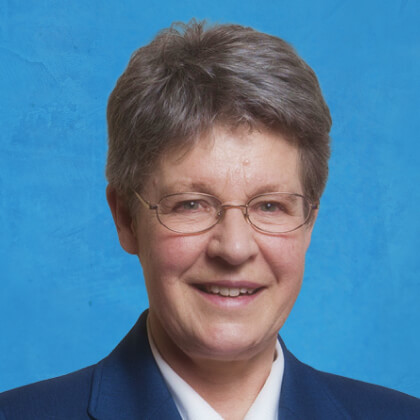
JOCELYN:
I'm this heathen from the north and west of the country. I don't belong in Cambridge. I’m stupid. Is what I'm thinking.
JOCELYN:
Even before I've left school, I do know that I want to be an astronomer, an astrophysicist.
MARY-ANN:
It’s the mid-1960s.
Twenty-two-year-old Jocelyn Bell leaves Northern Ireland for Cambridge, which has finally voted to grant degrees to women. Jocelyn has dreamed of becoming a scientist her whole life.
JOCELYN:
I also know it's a hard road and only a select few will get to do it.
MARY-ANN:
She’s here to get her PhD in astrophysics.
JOCELYN:
Cambridge, UK, is one of the major players in the game. So I turn up in Cambridge, and it's this frightfully suave place, and here am I from the north and west of the country, you know, the heathen parts of the universe as far as Cambridge is concerned.
MARY-ANN:
Her research involves logging radio waves from outer space.
JOCELYN:
It's a three-year project. I spent two years building the equipment. Not very sophisticated stuff. Involves quite a lot of sledgehammering. I became very strong. So I spent two years basically doing manual labor, building a radio telescope. And probably a first in history, it worked the first time it was switched on.
MARY-ANN:
She gets to work. Then, one day…
JOCELYN:
In amongst all the stuff, that I recognize, oh, yes, that's that radio galaxy, and that's the remains of that exploded star, and that's that, and that's that, I see a funny little signal that doesn't make sense. I have feet, hundreds of feet of chart paper, and this occupies about a quarter inch. So there's a quarter inch I can't understand, and being a stubborn old git, I pursue this quarter inch to understand what it is.
And it turns out to be a string of pulses. Something's going bleep, bleep, bleep, bleep, bleep, bleep. And you think, "Aha, satellite." But it's not a satellite. It's actually moving around with all the stars, and we don't have any satellite that does that. It's some funny kind of star or galaxy.
MARY-ANN:
Jocelyn doesn’t know what it is. Nor do any of her colleagues. Her supervisor is perplexed.
JOCELYN:
I think he doesn't like being puzzled, so he gets cross with me. Supervisor's privilege.
MARY-ANN:
He tells her there must be something wrong with her equipment.
JOCELYN:
And I'm a student, and I'm female, so I'm clearly very mistake-prone.
MARY-ANN:
But Jocelyn trusts her data. So she decides to investigate.
JOCELYN:
I don't say anything to my supervisor. I'm doing this privately. And I head out to the observatory. It's about midnight on a December night, and the equipment's misbehaving because it's cold, but I get it to behave for five minutes. I ended up finding four of these, all in different parts of the sky, all bleeping at different rates, but bleeping very, very steadily
And it turns out to be what we call now a pulsar, a radio source that goes bleep, bleep, bleep, bleep, bleep.
MARY-ANN:
A pulsar - a ‘pulsating star’ - is the remains of a star that exploded when it died.
JOCELYN:
But in the explosion, the core of that old star gets compressed rather than gets shattered. So it's the core of an old star that's been shrunk down to about 10 miles across, which is really very small by astronomical standards
MARY-ANN:
The discovery is momentous. A few years later, it wins the Nobel Prize for Physics. It’s the first time it’s ever gone to an astrophysicist.
JOCELYN:
And they awarded the Nobel Physics Prize jointly to my former PhD supervisor and the professor who headed up the department. And my supervisor's citation was for the discovery of pulsars
MARY-ANN:
Science is supposed to be objective; but scientists are human. And humans have prejudices. Jocelyn knows that story better than most.
JOCELYN:
As an undergraduate doing a physics degree, our class was 49 men and me, and none of the men would work with me, you know, on the homework, we had to hand in. So you get used to being a bit more self-sufficient if you're in a minority. It's harder work, but you probably learn more thoroughly, to be honest.
MARY-ANN:
It was during one of her long nights at the observatory, while studying for her PhD back in 1967, that Jocelyn’s radio telescope picked up a strange signal from outer space.
JOCELYN:
We ask a colleague and his grad student, who have a separate telescope and separate receiver and so on, to see if they can pick up this funny signal. My supervisor suspects I've wired something up wrong, and it's an artifact of our equipment. And I remember the day of that test very well. The way the telescopes were aligned, my telescope picks up the signal first, and it was bleeping away quite nicely. And then we went and stood by the recorder for the other telescope, and nothing happened. The two professors start walking down the corridor saying to each other, "Now, what could it be that shows in this telescope but not that one? Could it be... No, it can't be that. But what about... No." And I'm padding along behind them trying to keep up with this conversation. Robin, the other grad student, is still standing by his pen recorder, chart recorder, and suddenly there's a shriek from him. "Here it is!"
MARY-ANN:
Whoa.
JOCELYN:
He had miscalculated by 10 minutes when his telescope would see that bit of sky.
MARY-ANN:
Oh my goodness, wow.
JOCELYN:
If he'd miscalculated by 20 or 30 minutes, we'd have all gone home, and the story would be different.
MARY-ANN:
Did you learn to have the confidence to follow that up? Or do you think that's something intrinsic about your character?
JOCELYN:
I think it was the ambiance in Cambridge., there were very few women. I was very much an outsider, an oddity. I think probably with a tacit assumption amongst the men that I'd fail because I'm a woman. And so I'm doing my level best to counter that. I'm damn well going to show them that I'm capable, and I don't overlook things, and, you know, I'm reliable, et cetera, et cetera. So I'm following up this niggle, and look what it led to.
SOPHIE:
It's very, very hard for humans not to be strongly influenced by perceived authority or dominant social places in the hierarchy. Because like along with all other primate groups, we live not just in these social networks, but there is a hierarchy to them. It's unavoidable.
MARY-ANN:
Professor Sophie Scott is a cognitive neuroscientist from University College London, who’ll be popping in throughout the series to help us understand how trust manifests in our brains. Especially when, like Jocelyn, we’re working in a place with rigid hierarchies.
SOPHIE:
People always tend to think that the higher status individuals are the ones that are just better at everything. And so there's a big desire to be liked by those higher status people to get their attention.
MARY-ANN:
Sophie’s research focuses on how the way we communicate forms bonds. She’s especially interested in laughter.
SOPHIE:
There was this, I think, a study looking at junior doctors, working with like their consultant doctor going around doing the rounds and, um, the junior doctors laugh when the senior doctor, the consultant, makes a joke. When the junior doctors make a joke, the consultant doesn't laugh.
MARY-ANN:
Oh, cold.
SOPHIE:
It's attention and affection and potentially more possibility of enhancing your own status via that route. And, you know, it's sometimes a bit uncomfortable to think about it that way, and everyone likes to think, "Well, other people would be fooled by that. I wouldn't be." All of us are doing it to some extent. I think it's attractive to us, and it's attractive because it's speaking to a very basic and ancient human, um, need.
MARY-ANN:
As Jocelyn found out back in 1967, it takes some serious guts to go against that.
MARY-ANN:
I mean, you look at the history of the Royal Society, the society here in the UK, that celebrates the best scientists that we've ever had, and you see that, you know, for 300 years they wouldn't admit women at all. And even now, when women can be admitted as fellows they still haven't had a woman president. It's easy, isn't it, to kind of say, "Oh, well, those were the bad old days, but now we've understood and we've learned." But have we? Or are we still operating with those, those very kind of opaque, um, structures around who is actually trusted, who is trusted a bit more, who gets the opportunities to demonstrate their, their, their skill and their prowess?
JOCELYN:
Yeah, society changes slowly. Um, you know, I'd love to see a, a mega revolution, but I don't think that's going to help. Um, at least it is changing. But encouraging the women that there are, supporting the women that there are, um, is very, very important.
MARY-ANN:
In the six decades since she was a student at Cambridge, Jocelyn has become one of the world’s most respected astrophysicists - and one of the leading voices for making science more inclusive.
JOCELYN:
I think people fairly quickly saw that the Nobel Prize was perhaps not the wisest of decisions.
MARY-ANN:
In 2003, she was elected a Fellow of the Royal Society - nearly 60 years after the first women were finally admitted. In 2018, she won the Special Breakthrough Prize in Fundamental Physics.
JOCELYN:
One day I got a message that I'd been awarded a prize, okay, hold your breath, of 3 million US dollars.
MARY-ANN:
Whoa
JOCELYN:
Which is quite a lot of money.
MARY-ANN:
Yeah!
JOCELYN:
I ended up giving it to my professional body, the Institute of Physics, to provide research studentships for underrepresented groups in physics, primarily women, but also people with disabilities.
Maybe they haven't had a lot of money. Maybe they've done their undergraduate degree while working at the cash till in a supermarket and this kind of thing. The effort that these people have put in is absolutely staggering and it’s so good that they’re going to get the chance to do research and get a doctorate. They certainly deserve it.
MARY-ANN:
Brilliant. Amazing. If you could time travel back to have a quick chat with that 24-year-old Jocelyn sitting in a field about to flick the switch on your, your new radio telescope, what words of advice would you give her?
JOCELYN:
I think simply to hang in there, which is advice, the advice I've given myself most of life. Don't give up. It may be lonely. It probably indeed will be lonely. But you can do it.
If you respond to those, "You're not meant to be here," nothing changes. So keep going.
MARY-ANN:
Western science tried to solve a fundamental problem: how do we know what’s true when we can’t test everything for ourselves?
The answer was trust. Trust in the evidence, and in the scientific method. But the bottom line is, we also have to trust the people and institutions presenting it. And that means reputation matters.
And reputation can be exploited. Theranos is just one example.
But Elizabeth Holmes certainly didn’t invent the con.
Next time, we’re meeting the fraudsters and master manipulators who figured out how to build a reputation people couldn’t help but believe.
SOPHIE:
We want to believe people. Humans are terrible at spotting liars.
MARIA:
A con artist isn’t a good talker. A con artist is a good listener.
MARY-ANN:
Trust Forward is a podcast from Sumsub, AI-powered trust infrastructure for compliance operations at scale. It’s made in collaboration with This is Distorted.
It’s hosted by me, Mary-Ann Ochota. It’s written, produced, and sound designed by Anna Staufenberg.
Our Executive Producers are Alex Jungius & Anna Brusnik.
Thanks for listening.
Science is meant to be ruled by reason and evidence. But for centuries, only certain people were trusted to practise it.
In this episode, Mary-Ann Ochota takes us to Cambridge in 1897, where crowds gathered on the streets to protest against women being allowed to earn degrees. Journalist and author Angela Saini explains how the Royal Society, founded in 1660 on the radical idea of testing claims rather than simply trusting the person making them, became a gentlemen's club that kept women and working class scientists locked out for centuries.
It's a question that's shaped science ever since. If evidence is meant to speak for itself, why has reputation always mattered just as much, and what happens when that reputation is faked, as with Theranos founder Elizabeth Holmes, who convinced billionaires to back blood testing technology that never worked?
To help answer that, Mary-Ann talks to astrophysicist Dame Jocelyn Bell Burnell, who discovered pulsars as a PhD student in 1967 and had to fight to be believed by her own supervisor. Cognitive neuroscientist Professor Sophie Scott also joins to unpack why humans are so easily swayed by authority and status.
It's the next step in a story running from ancient coins to today's digital world, asking one slippery question: who gets to decide what's true?
Background on the protests against women receiving Cambridge degrees that open the episode.
Background on the Enlightenment and the rise of reason, evidence and empirical science.
Used to explore how scientific institutions developed and who was historically allowed to participate.
Background on Charlotte Murchison and the overlooked contributions of women to early science.
Background on attitudes towards women in Victorian science and their access to scientific work.
Background on Wallace, natural selection and how reputation shapes who gets remembered in science.
Background on Galileo and the struggle between scientific evidence, reputation and established authority.
Background on Theranos and how reputation and authority can be used to win trust without reliable evidence.
Background on Jocelyn Bell Burnell’s discovery of pulsars and her experience as a young scientist at Cambridge.
Scientific background on pulsars and the phenomenon at the centre of Jocelyn Bell Burnell’s discovery.
Money only works because we agree to trust it. From Roman coins to digital balances, this episode explores how belief between strangers became the foundation of the systems we still rely on today.
Con artists don’t steal trust, they build it. From the original confidence man to Ponzi schemes, how scammers turn confidence into their most powerful tool.
Even outlaws need rules. From pirate codes to Mafia rituals, how criminal groups build trust, enforce loyalty and keep order beyond the law.
Lloyd's Coffee House to R.G. Dun & Co. How reputation moved from conversation to ledger to algorithm. The moment trust stopped being personal and became a number.
Medieval merchant guilds to TikTok influence metrics. How the oldest reputation mechanism in history got rebuilt at planetary scale and immediately gamed.