



Episode 5 • coming soon

Before Spreadsheets, There Was Gossip
Lloyd's Coffee House to R.G. Dun & Co. How reputation moved from conversation to ledger to algorithm. The moment trust stopped being personal and became a number.
Episode 4 • Released: Oct 13, 2026
Even outlaws need rules. From pirate codes to Mafia rituals, how criminal groups build trust, enforce loyalty and keep order beyond the law.
REBECCA:
When pirates are attacking a ship, it is an extremely chaotic event.
Cutlasses blazing, guns blazing, yelling and screaming, and it's absolutely terrifying.
MARY-ANN:
It's the early 1700s, the height of the Golden Age of Piracy. We're somewhere in the Atlantic, far from land - and far from the reach of any government. This is one of the most lawless places on earth.
REBECCA:
The whole point of a fight isn't just to get the other ship to surrender, but it's also kind of to really show your cohesiveness and yourselves as a unit
MARY-ANN:
Rebecca Simon is a historian and expert in all things pirate.
REBECCA:
Making sure that you are getting what you're there to get, but also that you're protecting each other as well.
MARY-ANN:
The prize is whatever the other ship is carrying. Anything they can use to stock up their own dwindling supplies.
REBECCA:
Food, water, medicines, line, tackle, canvas to do their own repairs.
MARY-ANN:
And then there are the things the pirates can sell when they get back to land - perhaps in the infamous trading spots of Port Royal in Jamaica, or Nassau in the Bahamas.
REBECCA:
So this will be exciting. Like, ooh, big casks of wine, lots of sugar, lots of rum. Look, they've got all these cool fabrics. Like, that's expensive. Spices. These are the money makers.
MARY-ANN:
To the people cowering below deck, it sounds like they're being attacked by an unruly gang of thieves operating on instinct. But actually, that's not true. A pirate crew is organised and surprisingly disciplined.
REBECCA:
It's very dangerous to be a pirate, yes, because you're going after people, you're going after other ships, you are engaging in fighting. You could be captured, you could be executed. And so as a result, everything had to be very, very regimented on a pirate ship.
MARY-ANN:
Because for gangs who live outside the law like pirates, trust isn't a luxury. It's what keeps the whole operation together.
MARY-ANN:
What happens when the people who live outside society start making rules of their own? When trust becomes a more powerful bond than the law?
A conman might work alone. But pirates need a crew. The Mafia needs an organisation.
They might look like the ultimate outsiders: lawless, dangerous, answerable to nobody. But if you look closer, you'll see there are rules everywhere: who you can trust, who you answer to, and what happens when you break the code.
I'm Mary-Ann Ochota, and this is Trust Forward - a history podcast about how humans have decided what, and who, to believe.
Episode Four: The Code of the Underworld.
REBECCA:
Piracy has existed, you know, going back to the ancient world, pretty much since people knew how to sail. Many of them were mercenaries for a government or maybe, like, a financier and they were people who all very much had to work together.
MARY-ANN:
Rebecca's written extensively about the real lives of pirates. Her books The Pirates' Code and Pirate Queens get beneath the Hollywood version of piracy to look at how these crews actually lived, organised themselves, and what it took to make a life outside the law work.
REBECCA:
Pirates haven't just become popular in the 20th century. Pirates were actually very popular at the height of their activities in the 1600 and 1700s. People are able to read about pirates in newspapers. You know, printing has exploded and really taken off going into the 18th century. More people are literate than any other time in history, and if you're not literate, you know someone who is, and people are gathering all the time to read newspapers, read the news, discuss things. So everyone is also the most informed that they've ever been with the most up-to-date news of all time, like in the 1700s at that time in history. And so people found pirates really interesting because these are sailors who, for the most part, probably started off very poor and could potentially become wealthy, or at least going into what we would call a middle-class existence, which would've been a dream for the vast majority of people in Britain, colonial America, the Caribbean during the late 17th and early 18th centuries.
MARY-ANN:
Rebecca spends a lot of time busting myths about pirates. She says that Robert Louis Stevenson's book Treasure Island from the 1880s has a lot to answer for
REBECCA:
This is what's going to cause our big fascination with piracy. Everything we think we know about pirates comes from Treasure Island, actually. He based it on history, but also kind of created his own lore, such as, you know, buried treasure, X marks the spot, and it's been adapted many, many times, most famously in 1951 with Robert Newton, who played Long John Silver, gave us the pirate accent, gave us all the catchphrases like, "Arr, matey," you know, "Shiver me timbers," all of that.
MARY-ANN:
Wait, that's not... That's a recent invention?
REBECCA:
It is, yeah. Yeah,
MARY-ANN:
Oh my God. What?
REBECCA:
It is, yeah. Yeah, it comes from Robert Newton. Yeah. He's from, um, the southwest in England, I wanna say somewhere in Cornwall, I forget exactly where.
REBECCA:
Exactly. He exaggerated his accent, kind of imitating men from the coast that he grew up with, and that's where we get this idea from, and it's kind of permeated, you know, 20th century pop culture.
MARY-ANN:
Another myth that Rebecca likes to bust is the idea that pirates were an unruly bunch of lawless no-gooders.
REBECCA:
Pirates needed this aspect of trust to survive. Their roles on the pirate ship were very, very specific, and the rules on the pirate ship were extremely detailed, and the purpose was to make sure that pirates could survive at sea.
MARY-ANN:
They had the pirates' code - although Rebecca says it wasn't actually called that at the time. That's another myth. They called it the 'articles.'
REBECCA:
We know of about four pirates who had these sort of articles, um, such as John Phillips, um, Edward Teach, commonly known as Blackbeard, for example. And what they were is that they were a list of rules for law and order on the ship. So, you know, we think of the pirate code, we think of Pirates of the Caribbean, you know, "Keep to the code. He who falls behind, stays behind." That's not what the code was. The code was, "If you're injured, here's how much money you're gonna get based on what your injuries are. Here's how we're going to be doing distributions of goods. Here's how punishments are going to be dealt with. These are food rules, food and drinking rules, you know, about, like, meals and sharing food and whether or not drinking is allowed. Weapon regulation and safety. You know, is gambling allowed on a ship?" How money's distributed, and, you know, in terms of behavior, what's allowed and what's not allowed on a ship.
MARY-ANN:
The articles also set out who was paid what.
REBECCA:
The whole point is that even if you're brand new as like a cabin boy on a pirate ship, you'll be gettin paid the same amount as someone who's been doing it for years. So everything was done equally. No one is supposed to take more than what they get. Nothing is supposed to get hoarded. Nothing's supposed to be lied about. It is absolutely essential that they, these rules get followed. If you are caught stealing money that isn't yours, you could be executed on the ship. It could be collectively decided. Pirates also, in that vein, they had to collectively decide what a punishment would be. It kind of had to be a unanimous vote in a lot of ways. If they felt that the captain wasn't keeping promises, they could vote the captain out, you know? Everyone had to make sure that they knew their role, and everyone had to fulfill these roles as best as they possibly could in order to keep like this life on the pirate ship functioning very, very cohesively. And if they didn't, or if they weren't able to do that, then things very well could fall apart very, very quickly
MARY-ANN:
So for all the violence and lawlessness, there's actually a strong sense of fairness on board. Rebecca says pirates even had a form of health insurance.
REBECCA:
If they had certain injuries like losing a finger, losing an eye, losing a limb, they would get a payout for it. Quite substantial as well. So like, okay, once we paid those out, once we paid back any debts, okay, this is how much we have left. Now we're gonna distribute the money amongst the crew.
MARY-ANN:
I love the idea that this is the kind of the archetypal honor amongst thieves, right?
REBECCA:
Yeah, in a way. You really had to trust each other. You really had to make sure everyone was on the same page, and that everyone was going to follow these rules and be in agreement with each other. The second you have, like, a dissenting voice, well, everything could fall apart right away. This is how a mutiny starts, and the last thing you want on any ship, including a pirate ship, is a mutiny, 'cause it can destabilize the entire system.
MARY-ANN:
You can see why these rules mattered. They weren't just about keeping order. They were creating a microcosm of society at sea.
REBECCA:
What these pirate codes also did is it sort of, like, kinda set the entire society of the pirate ship, and so as a result, these will become part of the pirate's identity. And remember, pirates considered their ship to be their nation and their fellow crew members to be their countrymen in a lot of ways.
MARY-ANN:
And the rules didn't just govern money and punishment. They could govern who was allowed on board.
Take Blackbeard, for instance.
REBECCA:
So Edward Teach, commonly known as Blackbeard, was one of the most notorious pirates of the 1700s, and it's because of the way he looked. He had a very long black beard, he had long black hair. He would put kind of fuses into his hair during battle so smoke would rise from him, making it look like he came out of hell. And, he was very frightening, you know, the yelling and the screaming and commanding his men to look very violent. But he actually forbid people, his pirates, from killing people. He actually wasn't that violent. He was all about the intimidation. You know, we want a reputation of being terrifying, you know, so that way people will surrender. But we aren't gonna kill people. In fact, Blackbeard himself never killed anyone until his very last battle, the battle where he died.
MARY-ANN:
Wow I feel like I'm, having a very interesting emotional response to that, which is like, "Oh, that was, well, that was nice of him." And I'm like, "Wait, hang on a minute." "Oh, well, you know, what a stand-up guy."
REBECCA:
I know, right? Yeah. It's like, oh, it's like, yeah. It's like, oh, that's nice, but at the same time, you know, just because they didn't kill people doesn't mean that they aren't beating people and capturing people and yeah, exactly. Uh, but Blackbeard was a very kind of, you know, hold-the-line captain. He was very strict on his ship, he banned drinking, for example, felt it would just cause problems. Banned gambling, felt it could cause problems, and also banned relationships on his ship, it was one of the official articles. Um, and in the articles, what's interesting is that it says, "No women or boys to be brought onto the ships." Which can imply a lot of things, you know?
MARY-ANN:
And could you ever kind of leave piracy? You could say, "Okay, I'm gonna retire from being a pirate. I'm gonna go and be a kind of upstanding normal person now." Or once you're in, you're in forever?
REBECCA:
You could. The most common way to do this was to take a pardon, and this was something that the English government had set up as a way to try to combat piracy, and this was done through the Act of the Effectual Suppression of Piracy. And this began in the late 1600s, and the law was kind of, like, renewed a few times going into the early 18th century. And what it did is it promised if you go and you turn yourself in and name your accomplices, then you will not be tried as a criminal. You'll basically be let go, and you can even keep a lot of your own things. So that was the idea. Take a pardon, turn yourself in, and you can go back to being a law-abiding citizen. Now, some of these people might be pressed into the Navy for service because, hey, these are people who sail, and they're good fighters. Some of them would actually start working as pirate hunters for the government.
MARY-ANN:
Surely that breaches the code. Come on, that's a breach of trust, isn't it? Going hunting for your own countrymen
REBECCA:
Yeah, we don't like that, it's like the worst betrayal, essentially. But if someone's gonna leave piracy, it's going to be because they took a pardon, and many people did. The governor of the Bahamas, Woodes Rogers, who came into play around 1717, he issued pardons to I think about 200 pirates, 'cause he wanted it to be his goal to end piracy.
MARY-ANN:
Rebecca, imagine we're making a museum of trust 500 years from now. You get to pick one object from the history of the pirate world to put into our museum. What are you gonna pick?
REBECCA:
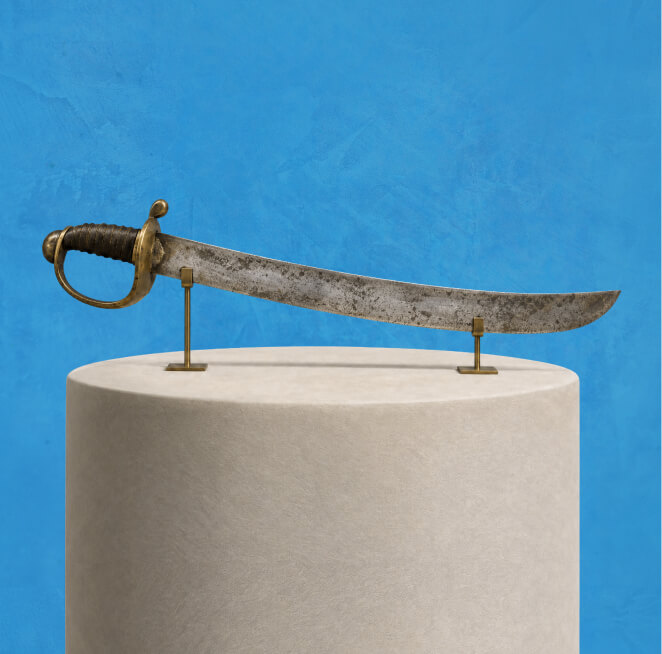
Honestly, the very first thing that kinda comes to my mind would probably be picking a cutlass. I think the cutlass kinda symbolizes so much. It symbolizes the pirate, it symbolizes the violence associated with pirates. It's like, wait, wouldn't that actually violate trust? It's like, yes, this course is gonna violate trust amongst the enemy or your perceived enemy or your victims, but at the same time, you know, having these weapons is really going to kinda show pirates' loyalty to each other and also the roles that they're playing in protecting each other as well.
MARY-ANN:
By the 1720s, governments were finally getting serious about hunting pirates down. Naval ships were sent after them, pardons were offered, and pirates who refused were captured and executed.
The message was clear. You could create your own little society outside the law, but eventually the law will catch up with you, and the golden age of piracy was coming to an end.
We see this phenomenon throughout history, of lawless groups operating outside of normal society having to find ways to create and maintain trust between their own members and with their own rule book.
And a more recent example of this is the criminal underworld of the mafia
FEDERICO:
We tend to think of mafias as being a phenomenon of, say, southern Italy, Russia, possibly Colombia or Latin America.
MARY-ANN:
Federico Varese is a professor of sociology and one of the world's leading experts on organised crime.
FEDERICO:
But there are also mafia-type organizations that nest in other countries, including the United Kingdom. This may not be fully fledged mafias as we know it in Sicily, but they do the same stuff. They basically become institutions of authorities in a community, and that is extremely dangerous because it, they undermine the official institutions and people then stop turning to the official institutions for justice.
MARY-ANN:
It's the 1990s, and Federico is conducting field research into the mafia, to understand how these groups work from the inside. He's spending a lot of time meeting and interviewing their members.
FEDERICO:
I did face, uh, awkward situations and, uh, engagement with people who could kill me if they want
MARY-ANN:
He's particularly interested in the Russian Mafia, and one summer sets off to a city in eastern Europe, to try and speak with some of them. He's put a lot of thought into how to gain their trust.
FEDERICO:
You don't just show up and want to talk to the criminal. I made a huge personal investment, into that field work, which lasted, you know, on and off at least nine months.
MARY-ANN:
He begins with the people who are more likely to talk - local business owners who are being targeted by the Mafia.
FEDERICO:
And then slowly from interviewing business people after a few months or after a few weeks maybe, I started to be offered to talk to the person they would pay protection money to.
And eventually, through this kind of chain of strange connections which lead, uh, you know, one from one to another
I was invited to meet, um, through a local politicians, in fact, to go to a meeting in a kind of outside the city. Um, so we drove quite a while. And at this meeting I didn't expect, but the boss was there and, and so that's how I met him.
MARY-ANN:
Federico is now sitting across from people who could seriously hurt him. And they want to know if he is who he says he is.
FEDERICO:
I was there on my own, and so in practice, I could have been, uh, in danger. The question of who I was was very strong in their mind. Because coming from Oxford, people have all kind of assumptions about Oxford and, and spies. But also being Italian, which is my nationality, people, you know, is he from the Sicilian Mafia?
MARY-ANN:
But the members of the gang are intrigued by this curious academic from Oxford University, and they begin to test his story.
FEDERICO:
They checked on me. So I remember after this first meeting, they took me by car back to my student hostel, and so they didn't allow me to go home on my own. They wanted me to be driven by them.
MARY-ANN:
A routine emerges. Whenever Federico has an interview with one of them, the car arrives to pick him up.
FEDERICO:
It's a mild way, it's a small form, but it's a way to test you, to make sure that you are who you pretend to be. And when you talk about yourself, there are, you know, 20 things you reveal about yourself, and you cannot test them all, but you can test five or six of them, and that can increases the likelihood that you are who you are, increases the trust between the two of us.
MARY-ANN:
And so against all the odds, Federico finds himself with unrivalled access into some of the most secretive and dangerous gangs the world has to offer. He's done it all by patiently gaining their trust.
FEDERICO:
And then inevitably somebody would talk about himself and about his own views. And it's very powerful 'cause people want to talk about themself and it's something that, uh, we all do to some extent.
MARY-ANN:
Over the years, Federico has collected some of the most in-depth knowledge of how the criminal underworld works.
And he says that, whether you're dealing with a mafia boss, a drug dealer or an undercover police officer, they all face the same fundamental problem: who can you trust? He calls it 'the trust problem'.
FEDERICO:
Mainstream society is, uh, is better equipped to solve the trust problem because we operate in the, in the open, right? And so, uh, you might not be sure that I'm going to stick to my word, but ultimately we can sign a contract or, uh, you can check my reputation online, so you can check whether I am, broadly speaking, trustworthy, whether, you know, I've been involved in untrustworthy activities before.
So there is an open flow of information, and also is a problem, generally speaking, it's a problem about the flow of information. You know, you cannot go to the internet and check, uh, or at least it's not as easy. Uh, so if you are a legitimate business person, you, you have a company and you can find out whether I was bankrupt, all of that.
You cannot really do that in the underworld. I would like to add also that, um, sometimes, uh, n- not because I'm untrustworthy, uh, I can disappear.
MARY-ANN:
So how do criminals solve that trust problem?
FEDERICO:
That's the key question, right? The best way i- but is not everywhere possible, is the existence of an institution in the illegal world which acts as a third-party enforcer of the trade So as much as we have the state to, to which, you know, you can take me to court, uh, with a contract, there are institutions in the underworld that operate exactly like that. So they are a court of last resort, and these are what I call the mafias. You know, mafias are really third-party enforcers of agreement and deals. And so, uh, if, uh, you and I don't trust each other, one way is to go through, uh, a mafioso who will ensure that we keep our promises. That's what fascinates me about mafias, because mafias are not just criminals that commit the individual crime. So mafias are not just about robbing and stealing or selling drugs. They're actually about ensuring that those who rob, steal, and sell drugs keep their promises.
MARY-ANN:
So the Mafia isn't just organising illegal activity. It can also provide something that, on the surface, looks surprisingly familiar: a way of making sure people keep their word.
But if you do a job in mainstream society, you can always choose to quit your job and do something else.
If you're in the mafia and know too much about murders, drug dealing, and dodgy business deals, your bosses can't afford for you to leave. So how do mafia bosses make sure their members stay loyal?
FEDERICO:
Well, that's a very good point. One way to build trust for a criminal organizations is the one from the, uh, Neapolitan Camorra that has been described by Roberto Saviano in his no- in his book.
MARY-ANN:
Roberto Saviano is an Italian journalist who infiltrated the Mafia group that rules Naples, for his bestselling book Gomorrah.
FEDERICO:
So what the Camorra boss did was to, uh, enlist all the members of his little gang in murdering somebody. Now, that is inefficient if you think of it, on the face of it, because you don't need eight people to kill somebody. Maybe you just need one or two. But by having everybody involved in the murder, you build, um, a commitment that you, that you're all responsible for this murder. Hence, you're less likely to, um, to defect, or at least you have a, a big, uh, problem because you are a murderer ultimately, not just a member of the group.
Another interesting example from the world of crime to build trust way is to recruit peoples of the same ethnicity, of the same ethnic groups. And if you recruit somebody from the same ethnic groups, you can then more easily punish, uh, him or his relatives if he misbehave.
MARY-ANN:
So whether it's a crime you're all implicated in or family ties that make leaving dangerous, the principle is the same.
Make the cost of betrayal high enough, and you make the group harder to break apart. And that brings us back to the pirates. In both worlds, the group needs ways of knowing you're committed, and once members have committed violent acts together, they see what someone's made of. Weirdly, it builds bonds of trust.
Federico has spent years studying this
FEDERICO:
Violence is not just about violence. So it's not about killing somebody or injuring somebody. It's also about conveying information or how I can trust you. You know, if, uh, you and I have to organize such a complicated operation, you know, committing an act of violence in a context which is, uh, you know, in Italy or in Russia where there is a police and everything, uh, you know, you need, I need ... I, I find out stuff about you. You know, how reliable you are, how smart you are, how good you are at doing things. And so, um, that study, um, allowed us to come to this kind of counterintuitive conclusion that committing acts of violence, uh, uh, allows people to trust each other on issues which are not related to violence.
MARY-ANN:
There's actually some evidence that violence has another role to play in criminal organisations - depending on whether their members are men or women.
Professor Sophie Scott, our resident cognitive neuroscientist, has been looking at research by the linguist Deborah Cameron into American gangs.
SOPHIE:
The female members of the gangs were much more strict around the rules than the male members of the gang, because the male members of the gang could get involved in the violent side of behavior, and the female members didn't. They're not physically strong enough. They're not as aggressive. So they were kind of, like, tighter around the rules than the... So a female pirate might be more like, "No, no, don't do that with the flag," than a male pirate. And it sounds facetious, but it's, you know, it's, it's kind of showing you how that plays down. And it's also pointing you to, the use of violence against your enemies as much as a threat within will be part of that kind of coherent, a part of the, you know, y-you're showing you belong
MARY-ANN:
Is that also the kind of basis, I guess, for kind of initiation ceremonies and hazing and trials where you have to kind of prove your belonging?
SOPHIE:
Yeah, exactly. Exactly. And the more violent or unpleasant it is, the more extreme, the more you're showing you belong by being prepared to tolerate it.
MARY-ANN:
So belonging itself can become a test. And the more costly the test, the harder it can be to walk away.
Federico says some Mafia organisations take that idea even further.
FEDERICO:
The Yakuza, for instance, in Japan, has got all its members, the body tattooed. And not only their bodies tattooed, but even if they commit a mistake, the fingers are cut off. Now, you can think of this as a cultural phenomenon, that Japanese people like tattoos, but really you can think of it as a way to build, uh, trust and commitment for the organization. Because once you have your body tattooed, it's very, ve- very hard to undo it, right? Especially as when you have your finger cut off. And so it's very hard for the person to leave the organization. And so it's a way to force commitment onto the member of the organization, who will then, uh, follow the rules.
MARY-ANN:
That might sound like a brutal cultural anomaly, but it highlights a fundamentally modern problem, how do you establish trust when talk is cheap?
You can't be sure who someone really is, you can't check their past, and you can't know if they're actually legit, that's almost exactly the problem we face online now. And when an organisation demands that level of permanent skin in the game to solve it, walking away becomes almost impossible.
Interestingly, the Japanese government has come up with a way of helping members of the Yakuza.
FEDERICO:
One of the things they do is precisely a program to reconstruct your fingers so that you can join society and not be seen as being a, a former member, making it easier to, to leave.
MARY-ANN:
So, so that that establishes a different identity that you can have, which gives, I guess, when we're thinking about the history of trust, that gives you an opportunity to build relationships in mainstream society that otherwise wouldn't be available to you.
FEDERICO:
Yes
MARY-ANN:
Wow. When you say it, it makes complete sense, but kind of the plastic surgery reconstruction of fingers is actually the thing that gives you the ability to leave
FEDERICO:
Yeah, exactly. Exactly. So these are small things you can do to, to fight organized crime, in a sense. So, uh, obviously arresting people is important and, an d fighting, uh, organized crime is important. But there are, um, other ways in which we can fight organized crime and, and make ... One is to make people easier to leave, to make it easier for people to leave the organization. And so this small project or program is very important.
But I also would like to say that we shouldn't paint people like me as heroes or, you know, spies or penetrating or... So I think there is a mistaken tendency to make, uh, people in my field as, uh, as sort of, um, heroes that go to the jungle and, uh, meet the savages and then come back and tell the story. The people you meet in the field, as you would know very well, are just like us. You know, they are just ordinary people who want to make a life and some take the wrong turn and, and become criminals. And there are rules of engagement that you can follow and if you're not stupid you would, um,, survive.
MARY-ANN:
Federico, in a society where there is a powerful and active mafia, how does that affect the kind of workings of, of m- the mainstream legal institutions and organizations?
FEDERICO:
Yes, I think it undermines the trust in the state, ultimately, uh, because, uh, the, the, these organizations, uh, do, do not operate according to, to rules, uh, of justice. And although we, we, we, we think they operate as third-party enforcers and quasi states, the, the world of the mafia is not a world of laws, right? It's not a world of rights. It's a world, a world where people ultimately are forced to do what, uh, the mafia wants.
So we should really not, uh, not, um, mythologize or romanticize this, uh, uh, these worlds of, uh, th- these parallel worlds. And so if you're a society which has got these entities, it undermines, uh, trust in meritocracy, in, in justice that the state should, uh, perform.
And also, what the mafia doesn't want is people to trust each other without its own presence. They don't want people to solve the trust problem on their own or through the state. They want the mafia to be the, the monopolist of, uh, the, the solution, right? So only because you go through the mafioso you can exchange or deal. The moment you go through the state or the moment you do it on your own and you just trust each other, uh, you are outside the realm of the mafia, and the mafia doesn't like that so it tries to undermine that, building of trust which is outside of its scope.
MARY-ANN:
Perhaps that is the thread running right through this. When we can't trust one another directly, we look for someone, or something, to do the trusting for us. In the world Federico studies, that role is claimed by the Mafia. In ours, it may be the state, but it's also corporations and the powerful systems that increasingly shape what, and who, we are encouraged to trust.
MARY-ANN:
Federico, we're making a museum of trust, say, five hundred years from now. I'd invite you to put one object from the criminal underworld, and what would that be? Something that shows how trust has flourished or how trust is broken.
FEDERICO:
That's a very good question. I would probably give you a photo of, uh, of a body with, uh, with the tattoos really, um, or, or, or a finger of a hand of a... with missing two fingers. Trust is not very high in this organization, so these are ways to build it, uh, so to create commitment.
MARY-ANN:
So, even outside the law - possibly especially outside the law - people need order. A way of knowing who you can trust. Pirates had articles. The Mafia has family ties, rituals like tattoos - and violence.
And for most of human history, the best ways to find out has been extremely simple: talking. Language. Gossip.
Next time, we're finding out how gossip became one of the hidden forces holding communities together - and what happens when that ancient system gets taken over by the machines
CATHY:
We cannot really imagine how big our audience is, and we're trying to have a somewhat private conversation, and suddenly it becomes viral, and it's blasted to the rest of the world.
TOM:
Even though the technologies of gossip have changed, essentially the desire to share information with other people, we've just found a variety of different and new ways to push the same old buttons in our Stone Age brains.
MARY-ANN:
Trust Forward is a podcast from Sumsub, AI-powered trust infrastructure for compliance operations at scale. It's made in collaboration with This is Distorted.
It's hosted by me, Mary-Ann Ochota. It's written and produced by Anna Staufenberg. This episode was mixed by Nick Thomson and Amy Thomson.
Our Executive Producer is Alex Jungius, and our Assistant Producer is Sian Heron.
The Executive Producer from Sumsub is Anna Brusnik.
Thanks for listening.
Pirates may look like the ultimate outsiders. Lawless, dangerous and answerable to nobody. But a pirate ship could not survive without rules.
Here had to be agreement over food, pay, discipline and what happened when someone was injured. In a world beyond the reach of government, trust was what kept the crew together.
In this episode, Mary-Ann Ochota explores the hidden codes that hold criminal worlds together. Pirate historian Rebecca Simon reveals that the real pirate “code” was not a Hollywood fantasy, but a set of articles that governed life on board. They set out how spoils were shared, how decisions were made and what happened when someone broke the rules. Even Blackbeard, one of history’s most feared pirates, depended on discipline and intimidation as much as violence.
Those same questions continue in the modern underworld. Criminologist Federico Varese explains how criminal groups solve the problem of trust when they cannot rely on contracts, courts or public reputations. From Mafia families to gang initiations, he shows how shared crimes, rituals and the threat of violence can create loyalty and make leaving extraordinarily difficult.
Professor Sophie Scott explores why costly tests of belonging can bind people to a group, even when that group is dangerous. Together, these stories reveal the darker side of trust. It’s not simply something freely given, but something that can be demanded, enforced and used as a weapon.



An introduction to the history of piracy, exploring the notorious figures, ships and events that defined the Golden Age of Piracy.
Official public record of Atlantic piracy in the 18th century.
The story of Edward Teach, better known as Blackbeard, one of the most infamous pirates of the Golden Age.
Historical legislation relating to piracy and maritime law, offering an insight into how piracy was defined and punished.
A biography of the privateer and colonial governor who played a significant role in suppressing piracy in the Caribbean.
An exploration of the emergence of the Russian mafia and the development of organised crime following the collapse of the Soviet Union.
Journalist and author Roberto Saviano reflects on his life under police protection after exposing the activities of the Italian mafia in his book Gomorrah.
An obituary reflecting on the life and work of Deborah Cameron, exploring her academic career and contributions to language and linguistics.
An overview of Japan's organised crime groups, exploring their history, structure and influence on Japanese society.
Money only works because we agree to trust it. From Roman coins to digital balances, this episode explores how belief between strangers became the foundation of the systems we still rely on today.
Science is built on evidence, but who gets trusted to produce it? From Cambridge protests to pulsars, how reputation and authority shaped who science believed.
Con artists don’t steal trust, they build it. From the original confidence man to Ponzi schemes, how scammers turn confidence into their most powerful tool.
Lloyd's Coffee House to R.G. Dun & Co. How reputation moved from conversation to ledger to algorithm. The moment trust stopped being personal and became a number.
Medieval merchant guilds to TikTok influence metrics. How the oldest reputation mechanism in history got rebuilt at planetary scale and immediately gamed.